This article is from The History of the Hayward Lakes Area; copyrighted by Eldon M Marple, 1976, Chicago Bay Graphix, Hayward, WI.
Eldon was my father. He was an astute and curious observer, an assiduous researcher and tireless writer.
The Indians were the first users of blueberries and in good years made of them a staple source of food, on a par with maple sugar, wild rice and the small amount of squash, beans and corn they grew. The berries were eaten raw in season or added to soups and stews and were dried in great quantity for winter use. The dried berries were sometimes pounded with “jerked” venison and deer or moose tallow or bear fat that was added to make pemmican.
And Indian friend of my boyhood, Dan Homesky, jokingly taught me the name the Indians used to describe the white man’s blueberry pie. It was long and complicated and when I wished to title this article “Blueberry Pie,” of course I could not remember it. Jimmy Mustache and Bill Sutton at Historyland, two the very few who still normally converse in the Chippewa language, spelled it out for me. Their translation simply describes the process of cooking or boiling “mi nan” and covering with a dough crust “like a shell” (Jimmy cupped his hands as he described this part!). The Indian family had to have many birchbark “makaks” full of dried berries stored for the winter. The settler’s wife did not rest until she had a hundred quarts canned and in her cellar.
Shortly after the North Wisconsin News was established in Hayward in 1883 an item appeared stating: “It seems to use from what reconnoitering we have done that the blueberry crop is going to be pretty thin, not enough to warrant any foreigners coming to pick, at any rate!” The paper usually reported the condition of the crop each year thereafter. Frost and drouth seem to have been the principal factors causing crop failures. Late frost at blossom time was the greatest hazard. In 1889 it was reported that the crop was ruined and in 1894 and 1895 it again said that heavy frosts killed the crop. On May 29, 1901, the paper reported that the blueberries were touched by frost and that the crop in the Namekagon valley between Hayward and Spooner was worth $75,000 per year, now lost!
Drouth was also a serious hazard to ripening a good crop, causing the berries to fail to fill out and shriveling up those left on the vines. Often fires came with the dry weather and burned out an area where a crop might have been harvested. In July of 1900 it was reported that all of the crop was destroyed by fire and frost.
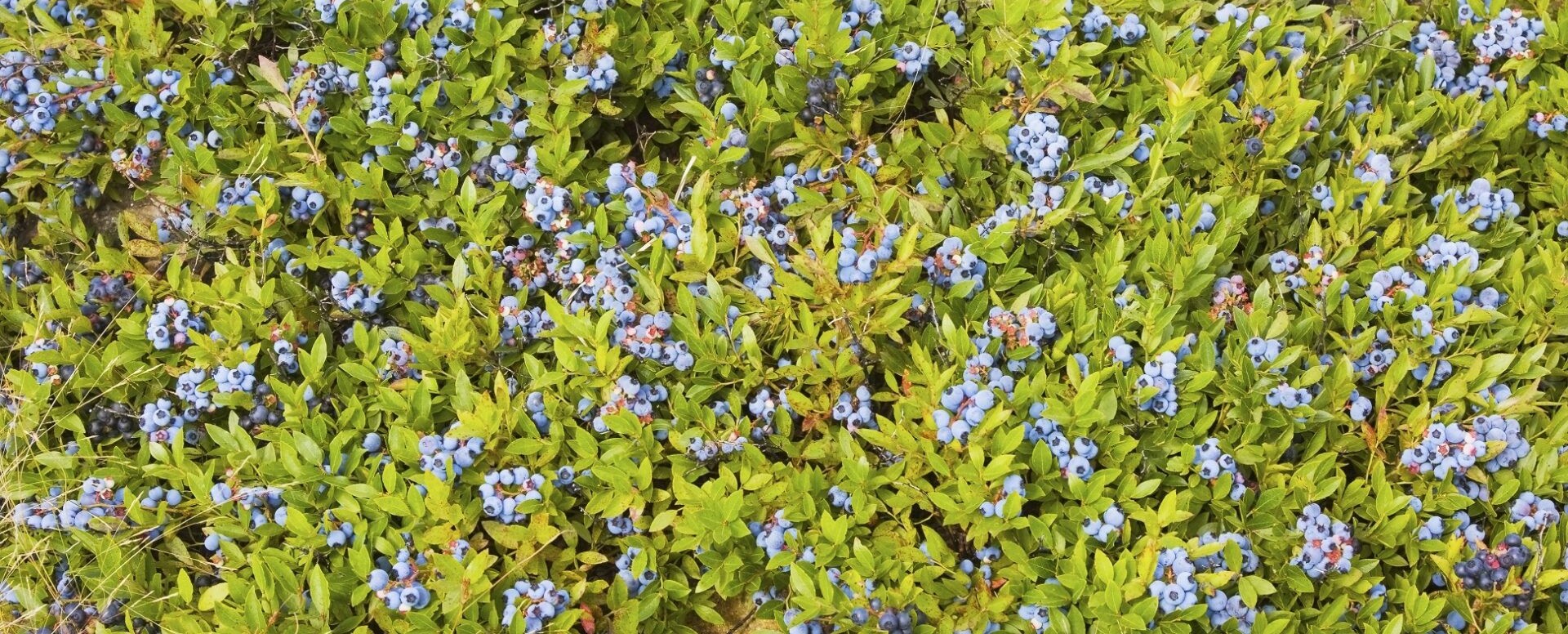
The reports from the newspaper about the bad years were offset by those reporting the good years. When they did come, it was impossible to harvest even a small part of the berries available. They grew in such profusion and abundance and over such a vast area that only the berry-stuffing bear, deer and birds ever saw most of them. Even in my memory, I have seen my boots and trousers stained with the frosty-blue bloom from the berries – a step could not be taken without crushing a handful of the pendant fruit. A cupped hand with slightly parted finger could rake a mouthful at one sweep! The bear gorged to the limit and would lie down and roll in the bushes in complete sufficiency.
In 1892 one dealer shipped 104 bushels to Kansas City from Hayward. He paid the Indians 10 cents a quart for them. Next week 500 bushels were shipped. In 1893 H.H. Ames was shipping from Springbrook, and the harvest was over by August 10. In 1896 the price was 10 cents per quart in June but had dropped to !1.40 a bushel by mid-July. In 1898, by July 21st, $15,000 worth of berries had been shipped out of Washburn County. In 1899, Joe LaRonger, who kept a store at Reserve, was dealing in berries at Superior Junction (Trego) and was paying 5 cents per quart. One of the bigger dealers of the pine barrens northwest of Hayward was Antoine Gordon who kept a store at Gordon. Art White of Round Lake used a four-horse team to haul his berries from the sandy plains on the Reservation to Hayward. He operated a “blueberry camp” there, furnishing board and bunk for his contract pickers. He always had a flair for doing things in a big way.
Most of the crop in the northwest area was shipped overnight to Chicago on the Soo Line where the berries arrived on the morning market, still fresh and with the dew on them. The railroad was dubbed “the Blueberry Line” because of this service. Conductors of trains up the Namekagon valley were known to stop the train at a likely spot and invite the passengers to alite and pick a hat – or apron – full! Passengers reported that the berries were in clusters as large and heavy as a bunch of grapes and that a person could eat his fill while sitting in one spot.
After reading these claims of endless abundance of the blueberry crop in olden times, I can hear your cries of disbelief or wonderment at what happened to end such largesse since there are so few now. Actually, the plant and its requirements for producing a crop are the same. What has changed is the environment! Fifty years ago, we decreed the end of free burning and made an all-out effort to end wildfires. We thus changed the character of our cut-over lands; from an almost treeless, brushy meadowland to an area of thick young timber with cold moist soil. The blueberry plant thrives best on a warm, acid, sandy soil where it gets full sunlight It will tolerate very little shade from other plants and the crop shrinks as forest regeneration takes place.
Conservation management people are well aware that heavy forest propagation eliminates the chance of a good blueberry crop. Thus, since we put such high priority on our growing forests and the two crops are mutually exclusive, we will have to be satisfied with what berries we can glean in forest glades and waste or burn areas before the forest regenerates. One of the most likely places to find good picking now is on a “forty” where jackpine has been recently clear-cut, or where wildfire got out of hand on sandy soil.
In the past, all of Northern Wisconsin not heavily timbered or marshy and with the lighter types of soil it was blueberry country. Perhaps the most striking area (and still the heaviest bearing) is the so-called “Pine Barrens” which sweep southwestward from the Bayfield peninsular for 125 miles across four counties, the bed of a miles-wide sandy bottomed river which drained Lake Superior in glacial times. Here, when the season is right and the jackpine not too high or thick, is a picker’s delight!
The blueberry plant growing wild in this region is of the “low bush” type, usually Vaccinium angustifolium – sweet, frosty blue with a skinny leaf. Another species, V. Brittoni – small, black berries with a greyish-green foliage is also common, usually in bog areas. It is often called a huckleberry and both may be called whortleberries. V.Myrtilloides and V. Lamarckii are also found here. Anyu of these species react well to field management but are not grown in the cultivated rows. A single plant under favorable conditions will spread by rhizomes into a clone several feet across. Thus, a field with a moderate stand of scatter plants will soon be matted with vines.
A definite effort has been made by those who manage our public and commercial forests to retain and develop some areas for family-type blueberry picking this has been done in the St. Croix-Totogatic River area, part of the Pine Barrens, in Burnett County in conjunction with sharptailed grouse and prairie chicken management, which require a similar habitat to blueberries. Several thousand acres of this land has been bulldozed and burned over to keep down high brush and trees. Other counties and state and federal forests have followed alike course of reversing the solid forest trend to benefit the casual picker and bird hunter.
In 1968 the management people mentioned above, representing the Federal, State and County forestry departments, the Soil Conservation Service and the University Experimental and Extension divisions met to consider the need for more emphasis on open areas for blueberry and game management. I had the privilege of opening the meeting with a short discourse on the historical background of berry picking in this area.
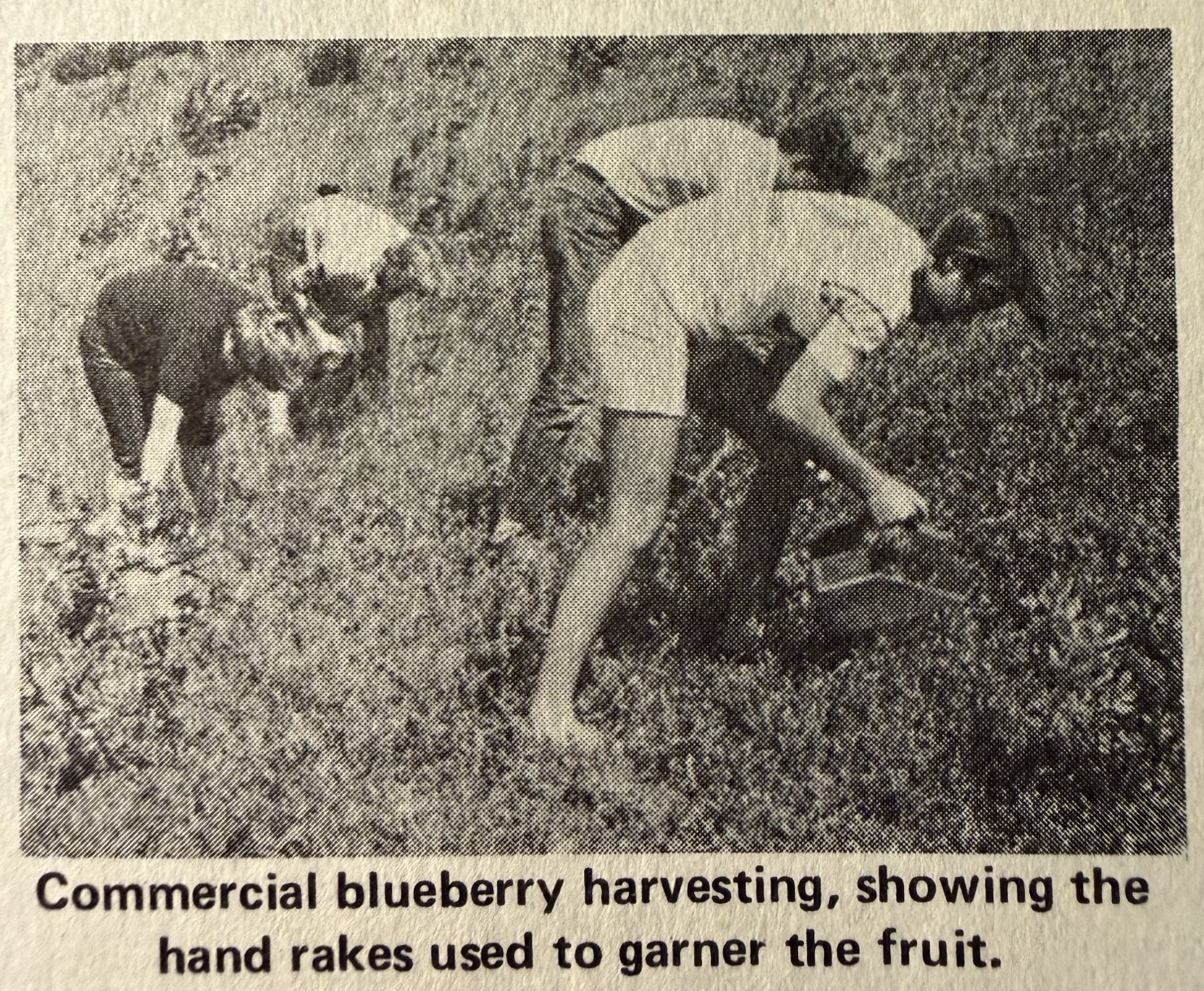
The technicians present at this meeting were mostly in favor of enlarging the “forest spaces” policy, I was invited to show slide I had taken of forest-blueberry land owned by my son, Wesley, in central Maine. Here blueberry growing is considered the highest economic land use and one county along has over 100,000 acres of wild blueberries grown as a managed crop. To do this in a commercial way in Wisconsin would require a great amount of study and experimentation. However, there is no doubt that a crop suitably developed for our family-type pickers could be greatly augmented by using a limited amount of management.